The Precision Problem: How Off-Target CRISPR Edits Threaten the Future of Gene Editing Therapies
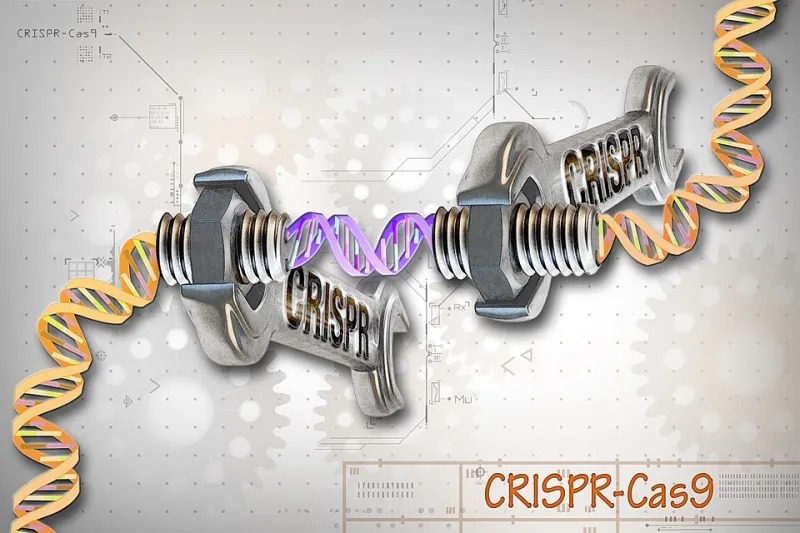
Photo: Ernesto del Aguila III, NHGRI, Public domain, via Wikimedia Commons
The approval of Casgevy in late 2023 — the first CRISPR-based therapy to receive authorization from the U.S. Food and Drug Administration — was widely heralded as a landmark moment for gene editing. Developed by Vertex Pharmaceuticals and CRISPR Therapeutics to treat sickle cell disease and transfusion-dependent beta-thalassemia, the therapy demonstrated compelling clinical results and cleared a regulatory bar that many in the field had long anticipated. The milestone was real. But within the scientific community, a quieter and more uncomfortable conversation was already underway.
For all of CRISPR's extraordinary precision relative to earlier gene editing platforms, it is not infallible. The Cas9 enzyme that executes the cut can, under certain conditions, act at genomic locations other than the intended target — sites that share partial sequence similarity with the guide RNA directing the enzyme. These off-target edits are, in most cases, biologically inconsequential. In some cases, however, they are not. And as the number of CRISPR-based therapies advancing through clinical trials continues to grow, the scientific, regulatory, and ethical stakes attached to this vulnerability are escalating accordingly.
Understanding the Mechanism of Mismatch
To appreciate why off-target editing occurs, it helps to understand how the CRISPR-Cas9 system navigates the genome. The guide RNA — a short, programmable sequence — directs Cas9 to a complementary stretch of DNA. When a match is found, Cas9 cleaves both strands of the double helix. The cell's own repair machinery then resolves the break, either through error-prone mechanisms that disrupt the target gene or through template-directed pathways that can introduce a desired sequence.
The problem arises because the base-pairing rules governing guide RNA binding tolerate a degree of imperfection. A guide RNA designed to match one specific 20-nucleotide sequence may also bind — with lower efficiency but meaningful frequency — to sequences that differ by one, two, or even three nucleotides. Given that the human genome contains approximately three billion base pairs, the number of near-match sites can be substantial. Most of those sites will be located in non-coding regions or will produce edits without functional consequence. But a subset may fall within or near genes involved in cell cycle regulation, tumor suppression, or other processes where unintended disruption carries genuine risk.
The concern is not merely theoretical. Insertional mutagenesis — the disruption of critical genes by external genetic elements — contributed to serious adverse events in early gene therapy trials using retroviral vectors. While CRISPR's mechanism differs, the underlying logic of genomic vulnerability is the same.
Detection in the Age of High-Sensitivity Genomics
The good news is that the field's ability to detect off-target edits has improved substantially over the past several years. A range of methods is now available, each with distinct sensitivity profiles and practical tradeoffs.
Unbiased, genome-wide detection approaches — including GUIDE-seq, CIRCLE-seq, and DISCOVER-Seq — can identify off-target sites without prior knowledge of where they might occur. These methods work by capturing DNA double-strand breaks across the genome and sequencing the surrounding regions, producing a map of editing activity that extends well beyond the intended target. In preclinical settings, they have proven effective at identifying low-frequency off-target events that would be invisible to earlier analytical techniques.
In clinical contexts, the challenge intensifies. Patient-derived cells treated with a CRISPR therapy may exhibit off-target editing at frequencies below one in ten thousand alleles — events that require extremely deep sequencing and sophisticated computational analysis to detect reliably. Rhyno Genomics and several academic consortia have been developing long-read sequencing platforms that may improve sensitivity further, though the cost and complexity of these approaches remain significant barriers to routine clinical implementation.
The FDA has indicated that sponsors seeking Investigational New Drug status for CRISPR-based therapies should conduct comprehensive off-target analyses, but the agency has stopped short of specifying a universal threshold below which off-target activity is deemed acceptable. This ambiguity leaves sponsors navigating a moving target — and gives critics of the current regulatory framework ample grounds for concern.
Clinical Trials and the Informed Consent Dilemma
For patients enrolling in CRISPR-based clinical trials, the off-target question surfaces most acutely in the informed consent process. Communicating the nature and magnitude of genomic risks to individuals who may be living with severe, life-limiting conditions — and who may have few or no alternative treatment options — is a task that combines scientific complexity with profound ethical weight.
Clinicians running CRISPR trials at major academic medical centers have described the challenge candidly. The consent conversation must convey that while off-target editing is a known phenomenon, its long-term consequences in any individual patient cannot be fully predicted. Oncogenic transformation — the theoretical possibility that an off-target edit could activate a proto-oncogene or disable a tumor suppressor — remains a concern that is difficult to quantify but impossible to dismiss entirely. The latency period for such effects could extend years or decades beyond the initial treatment.
Some bioethicists argue that current consent frameworks are inadequate for this level of genomic uncertainty. They contend that patients should be offered long-term genomic monitoring as a standard component of trial participation — not merely as an option, but as an obligation owed by sponsors who are, in effect, asking individuals to accept incompletely characterized biological risks in service of scientific progress.
Next-Generation Editing Systems: A Partial Answer
One response to the off-target challenge has been the development of editing platforms designed to reduce unintended activity at the molecular level. High-fidelity Cas9 variants — including eSpCas9, HiFi Cas9, and HypaCas9 — carry mutations that tighten the enzyme's specificity requirements, reducing tolerance for mismatched base pairs and thereby lowering off-target activity without substantially compromising on-target efficiency.
Base editing and prime editing, which were explored extensively in the context of precision gene correction in a previous Scramble Life Sciences analysis, offer additional advantages. Because these technologies modify individual nucleotides without introducing double-strand breaks, they reduce the risk of large chromosomal rearrangements that can accompany conventional CRISPR cutting. However, base editors carry their own off-target profile — including RNA editing activity — and prime editors, while highly precise, are still being optimized for delivery efficiency in vivo.
The emerging consensus among researchers is that no single platform will be universally optimal. The appropriate editing tool will depend on the specific genetic target, the tissue being treated, the delivery method employed, and the patient population in question. This nuance complicates both drug development strategy and regulatory evaluation.
What Regulators and Researchers Agree On
Despite the uncertainties, there is broad agreement within the field on several foundational principles. Comprehensive off-target characterization should be conducted prior to any human dosing, using the most sensitive available detection methods. Long-term follow-up of trial participants — extending at least fifteen years in the case of therapies that modify hematopoietic stem cells — should be considered a standard requirement rather than an optional commitment. And the scientific community should resist the temptation to treat regulatory approval of early CRISPR therapies as evidence that the off-target question has been resolved, when in fact it has been managed under specific and not universally applicable conditions.
The FDA's Center for Biologics Evaluation and Research has signaled an increasing willingness to engage with the scientific literature on editing specificity and to incorporate emerging detection standards into its guidance documents. That engagement is welcome. But the pace of clinical development in this space is accelerating faster than the regulatory science is evolving, and the gap between the two carries consequences that extend well beyond any individual trial.
The field that brought gene editing from a laboratory curiosity to an approved human therapy in under a decade now faces the harder work of ensuring that its ambitions are matched by the rigor required to protect the patients who have placed their trust in it.