Seven Ways Biology Is Rewriting Your Grocery List — and Which Ones Are Actually Real
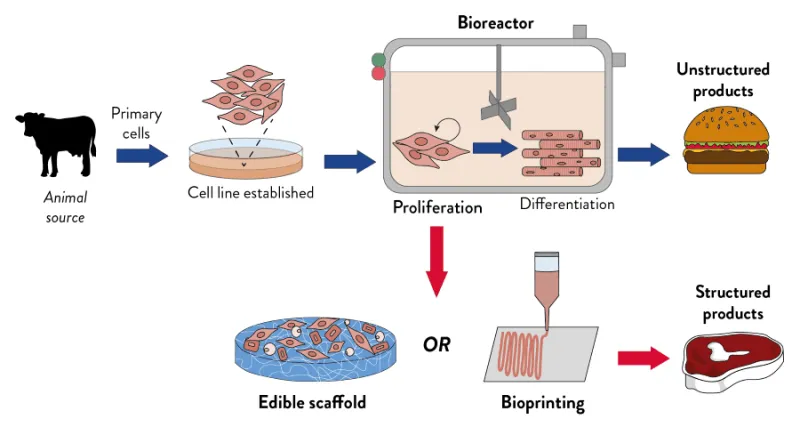
Photo: cultivated meat laboratory bioreactor food biotechnology, via substackcdn.com
Food biotech has a storytelling problem. The industry sells revolution; the consumer sees a $12 burger and a press release. Between those two points sits a genuine scientific accomplishment, a brutal manufacturing problem, and in some cases a good deal of venture-capital theater. As these products move from conference booths to American supermarket shelves, it's worth asking a blunt question about each category: is the biology real, and can it survive contact with economics?
Here is a field guide, graded accordingly.
1. Cultivated Meat — Science: A. Scalability: C
Growing skeletal muscle tissue from animal cells in bioreactors is a legitimate biological achievement, and the FDA's clearance of early cultivated chicken products marked a real regulatory milestone. But the engineering challenge is staggering. Meat is structured tissue, not a homogeneous broth; producing it at scale requires culture media that once cost tens of thousands of dollars per liter, and while prices have fallen dramatically, they have not fallen to commodity levels. The biology works. The unit economics, mostly, do not yet.
2. Precision Fermentation — Science: A. Scalability: A−
This is the category that actually delivers. Insert a gene for a milk protein into yeast, ferment it like beer, isolate the protein, and you have genuine whey or casein without the cow. The biology is textbook molecular biology, the manufacturing leverages a century of industrial fermentation infrastructure, and the products — from animal-free dairy proteins to egg proteins — are chemically identical to their conventional counterparts. If one category in this list replaces a meaningful share of an animal product within a decade, it's this one.
3. Plant-Based Meat Analogs — Science: B. Marketing: D
The extrusion technology that turns pea and soy protein into something resembling muscle texture is real food science. But a decade of overpromising — the claim that these products would rapidly replace conventional meat — has met the stubborn realities of consumer behavior, repeat purchase rates, and the fact that taste remains a hard ceiling. This is less a biological breakthrough than a processing achievement wrapped in a mission statement the science can't fully support.
4. Precision-Bred Animals — Science: A−. Public Acceptance: Incomplete
Gene editing livestock — hornless cattle, disease-resistant pigs — is sophisticated and, in the case of the FDA-cleared gene-edited pig developed to resist a devastating virus, genuinely valuable. The science is solid. The open question is cultural: American consumers have spent decades being trained to fear genetically modified food, and no amount of regulatory clearance settles that argument. Watch this category closely; its fate will be decided at the ballot box and the checkout line, not in the lab.
5. Fermentation-Derived Fats — Science: B+. Scalability: B
Cultivating real animal fat cells, or engineering microbes to produce specific triglycerides, addresses the single biggest flavor gap in alternative proteins: fat carries taste. The chemistry is sound and the value proposition is clear as an ingredient business. As a consumer-facing category, it barely exists yet — and its future is likely as a B2B input rather than a shelf product.
6. 3D-Printed Food — Science: C+. Narrative: A
Food printing is a legitimate technique for structured products, particularly in clinical nutrition where texture-modified meals for dysphagia patients are a real and underserved need. But as a mass-market category, it is largely a demonstration technology — visually striking, functionally limited, and consistently overhyped by companies whose actual product is closer to extruded paste than printed steak. Grade the patient-nutrition applications well. Grade the TED talks accordingly.
7. Upcycled Ingredients via Microbial Conversion — Science: B+. Scalability: Untested at Scale
Using engineered microbes to convert food waste, carbon streams, or agricultural byproducts into edible protein is one of the more intellectually compelling ideas in the space — closing a waste loop while producing nutrition. The biochemistry works in pilot settings. Whether it works in Kansas at a million-liter scale, with all the contamination, regulation, and cost pressures that entails, is the question no one has fully answered yet.
The Pattern Worth Noticing
Look across these grades and a pattern emerges: the categories with the strongest biology are not the ones with the loudest marketing. Precision fermentation succeeds because it borrows existing industrial machinery and makes a chemically identical product. Cultivated meat struggles because it asks biology to do something structurally difficult at commodity cost. And the categories with the grandest narratives — printed food, replacement meat — are precisely the ones where the engineering gap between prototype and grocery aisle remains widest.
American consumers will ultimately render the verdict, one purchase at a time. But they deserve to make it with clear eyes about what each product actually is: which ones represent genuine biological innovation, which ones represent clever processing, and which ones represent a pitch deck in search of a protein. The science, for once, is the easy part.